Many people who speak Pennsylvania Dutch call it an unwritten language because, as far as they know, it never is written. But does the fact that a language usually isn’t written mean that it is inherently inferior and cannot be written? Obviously not. In fact, there are two official writing systems for Pennsylvania Dutch:
- a German-based system that was created by Albert F. Buffington, Preston Albert Barba, and C. Richard Beam (the BBB system), and
2. An English-based system that was created by Hank and Ruth Hershberger when they translated the Bible into Pennsylvania Dutch (Di Heilich Shrift).
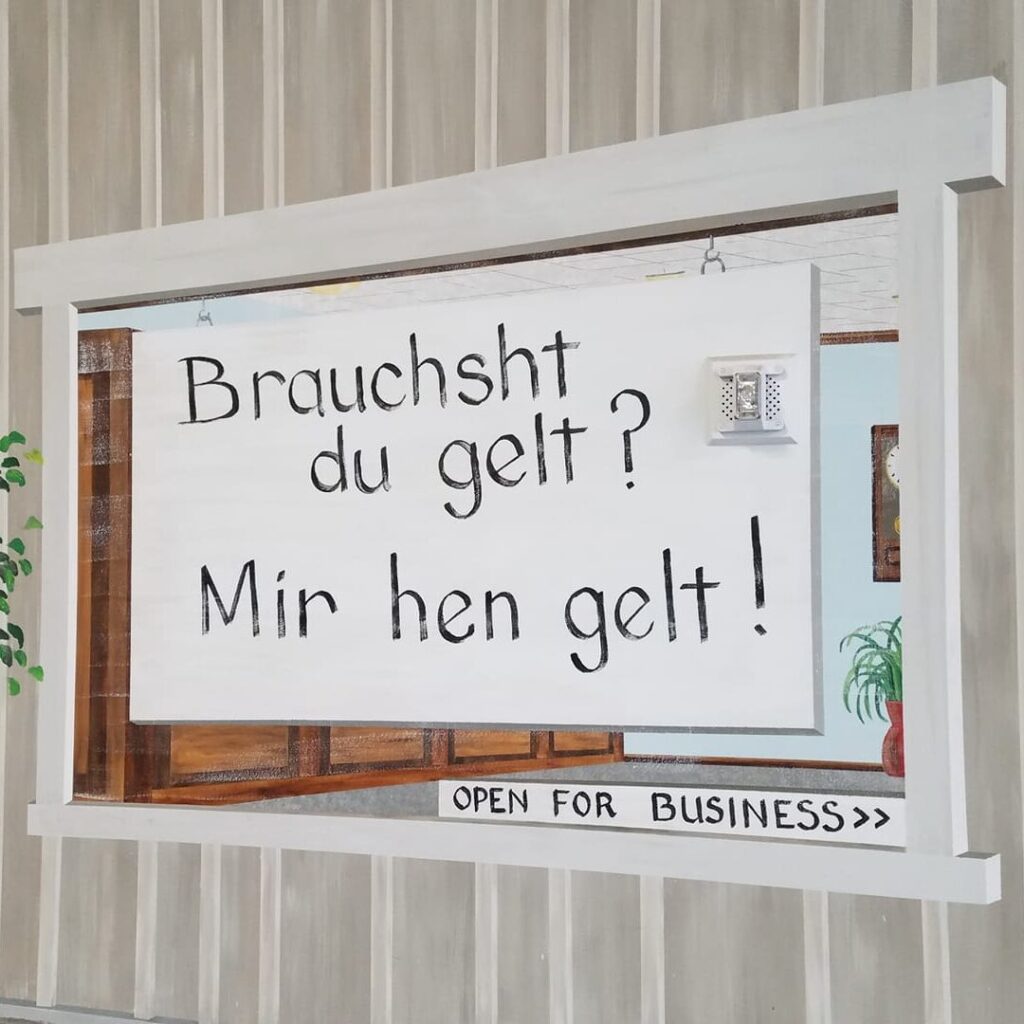
Photo courtesy of Michael T. Putnam.
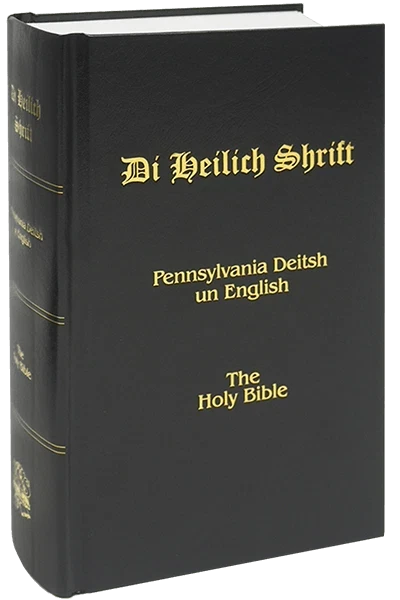
1Wu Jesus die viel Leit gsehne hot, iss er nuff uff en Hiwwel gange un hot sich anne ghockt. Sei Yinger sin zu ihm kumme.
2Er hot aagfange sie lanne un hot gsaat,
1Vo Jesus dee feel leit ksenna hott, is eah nuff uff en hivvel ganga un hott sich annah kokt. Sei yingah sinn zu eem kumma.
2Eah hott ohkfanga si lanna, un hott ksawt,
Even though the German-based BBB system might be a little harder to learn for people who are used to writing in English, we think it’s worth the effort to learn the German one because it shows the close relationship between German and Pennsylvania Dutch better. Because Pennsylvania Dutch really is a German variety, we use the German-based (BBB) system when we write in Pennsylvania Dutch. This can also be helpful for anyone who wants to learn to understand written German better or for Germans who are interested in reading Pennsylvania Dutch because the similarities make it easy to switch from one to the other. There’s even an online dictionary for the BBB system available at padutchdictionary.com!
Here’s a little example of a poem written in Pennsylvania Dutch (using the BBB system) that was translated into English by Mark Louden and was taken from his website (https://padutch.net/schwetz-deitsch/):
“Schwetz Deitsch” (Speak Pennsylvania Dutch)
Ernest G. Gehman
Saag, kannscht du Deitsch schwetze?
Un kannscht du’s verschteh?
Dutt’s Englisch dich petze?
Macht’s Deitsch dir Heemweh?
Es Deitsch geht zu Schadde,
Un sell iss doch schaad!
Die Eldre hen’s ghadde
Vum Kindsbett zu Laad.
Mer sott’s net verliere,
Sell daerf yuscht net sei!
Was naus geht mit Eldre
Kummt gaar nimmi rei.
Dann schwetz Deitsch, du Amischer!
Du Luddrischer, du Gedolischer, du Dunker,
Schwetz Deitsch, du Mennischt!
Schwetz Deitsch, du wer-, wie-, wu-,
Was-ewwer du bischt!
Say, can you speak PA Dutch?
And can you understand it?
Does English “pinch” you?
Doe PA Dutch make you homesick?
PA Dutch is fading,
And that is too bad!
The parents had it
From the cradle to the coffin.
It shouldn’t be lost,
That just may not be!
What goes out with parents
Will never return.
The talk Dutch, you Amishman!
You Lutheran, you Catholic, you Dunkard,
Talk Dutch, you Mennonite!
Talk Dutch, you who-, how-, where-,
Whatever you are!
There are many such examples of written Pennsylvania Dutch if you know where to look for them. However, it is still true that Pennsylvania Dutch in Amish and Mennonite communities is usually spoken and only very rarely written. That is why this project is designed to deal primarily with spoken language.