There are many people who speak Pennsylvania Dutch but know very little about where it came from or how it came about. If that’s you, it’s great that you’re here! Pennsylvania Dutch is a German language variety because it comes from a mixture of German dialects. The most important and influential one is called Pfälzisch in German or Palatine German in English. It is spoken in the southwest of modern Germany in a region called the Rhineland-Palatinate (in red on the map below; Louden 2016: pg. 32-33).
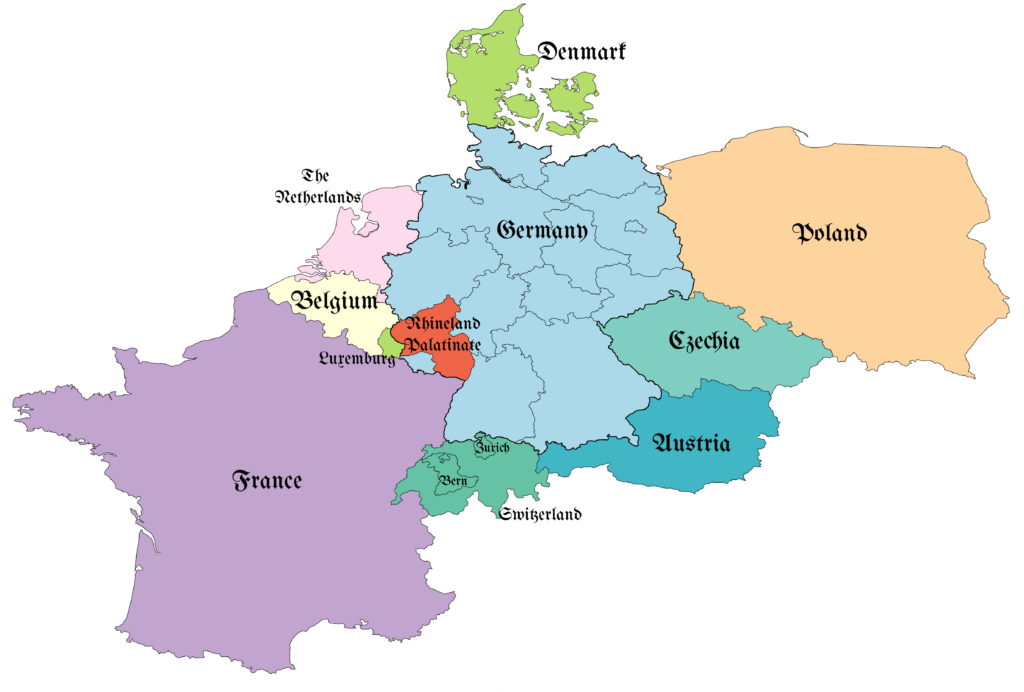
Many of the ancestors of modern Anabaptists (like the Amish and Mennonites) were Swiss, but because of persecution in Switzerland in the 1500s and 1600s, they moved into the Rhineland-Palatinate region of what is now Germany in the 1600’s. After about two generations there, they continued on to Pennsylvania arriving in the New World in waves between 1683 and 1775 (Louden 2016: pg. 74). During that short time in the Palatinate, they switched from Swiss German to Palatine German. This is why Pennsylvania Dutch is most similar to Palatine German dialects. Speakers of Pennsylvania Dutch will probably have an easier time understanding someone who speaks Palatine German (or dialects spoken in other places in southern Germany or even Switzerland) compared to someone who speaks modern Standard German, which developed out of German dialects further north.
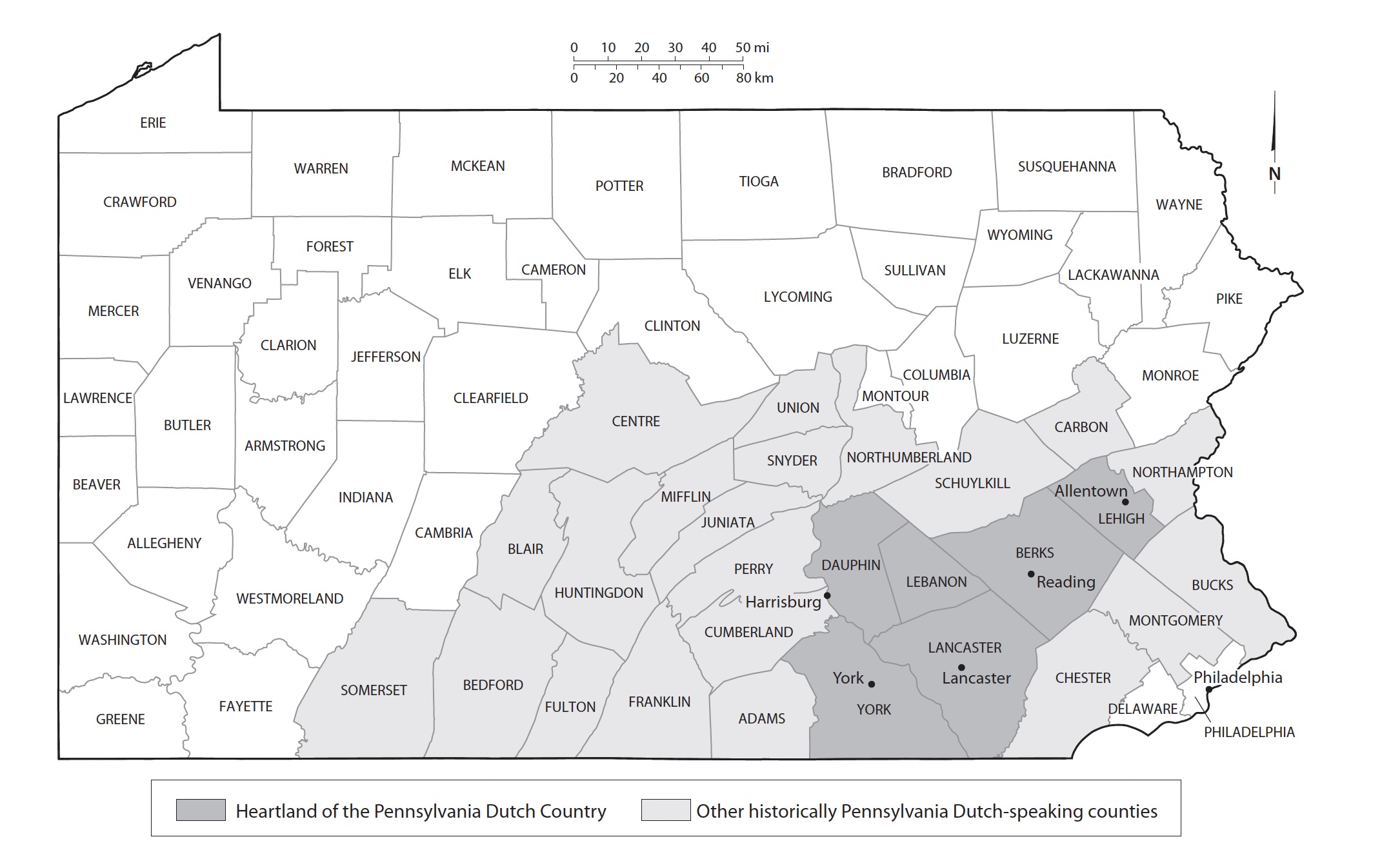
It’s interesting to note that even though nowadays most Pennsylvania Dutch speakers are Anabaptists (see this Wikipedia page on Anabaptists for more info), this was not always the case. The vast majority of Pennsylvania Dutch speakers (around 95% of the original immigrant group!) belonged to non-Anabaptist groups like the Lutheran and German Reformed churches and they lived mostly in Pennsylvania (Louden 2016: pg. 62). In fact, 200-300 years ago much of the backwoods of Pennsylvania used to be German/Pennsylvania Dutch-speaking and many regular people living there did not even speak English. Like with so many other immigrant languages, Pennsylvania Dutch was gradually displaced by English. That is why it is now primarily the Old Order Mennonites and the Amish, Anabaptist groups who strictly separate themselves from mainstream society, that make up the majority of Pennsylvania Dutch speakers. However, many people in Pennsylvania and beyond still consider themselves to be Pennsylvania Dutch even though they may not speak the language.
People have wondered why you would call the language and people Pennsylvania Dutch if they speak German and not Netherlandic Dutch. The answer Mark Louden gives in his (2016) book Pennsylvania Dutch: The Story of an American Language (pg. 23-25) is that in the 1700s when the immigrants who became the Pennsylvania Dutch landed in Pennsylvania (which was before the Netherlands and Germany existed as we know them today), everyone who came from the Dutch- and German-speaking parts of Europe were informally referred to in American English as Dutch. This name is the one that stuck. People who speak the language still use Dutch (or sometimes Amish) to talk about the language in English. They do not call it Pennsylvania German, so neither do we. All of this information and much more can be found in Mark Louden’s informative book.
Cover image courtesy of Johns Hopkins University Press.